When two oscillators are hard-synchronised, then if the master frequency is lower than the slave frequency, changing the pitch of the slave changes the timbre of the output.
via Synth Secrets
Audio interloper
When two oscillators are hard-synchronised, then if the master frequency is lower than the slave frequency, changing the pitch of the slave changes the timbre of the output.
via Synth Secrets
Now, the Waldorf Pulse: attack 0 means 1.9ms. 1.9ms is equal to around 523 Hz with this simple calculation: 1 divided by seconds = Hz So: 1 / 0.0019 is around 523 Hz. This in turn means: you can hear a click in the attack phase that has a maximum frequency of 523Hz which is already easily noticable. When you now turn the amp attack rate to 1, you have 2 x 1.9ms = 3.8ms = 261Hz. Ah, that’s hollower. But still too bright when you play a low and hollow bass sound. When you e.g. play a hollow bass sound with around 80Hz base frequency, you have to make sure that the attack envelope is no shorter than 12.5ms to prevent *any* click. And this is an amp attack value of around 6 on the Pulse!!
Patches, docs, instrument definitions for the Waldorf Pulse.
Index of /pulse (old Waldorf site)
A real-time MIDI synth editor that allows you full control of every parameter of the sound on the Waldorf Pulse.
Looks nice but a bit pricey at 70 clams. I’ve made an X-station map and it’s working nice, but I need the precision provided by a software editor. That said, there are not many parameters, so I could knock something-up in Synthmaker.
On the other hand, there is this free (non-VST) editor from Granucon.
Having lots of fun with the Pulse – very expressive monosynth that begs to be tweaked. The filter sings!
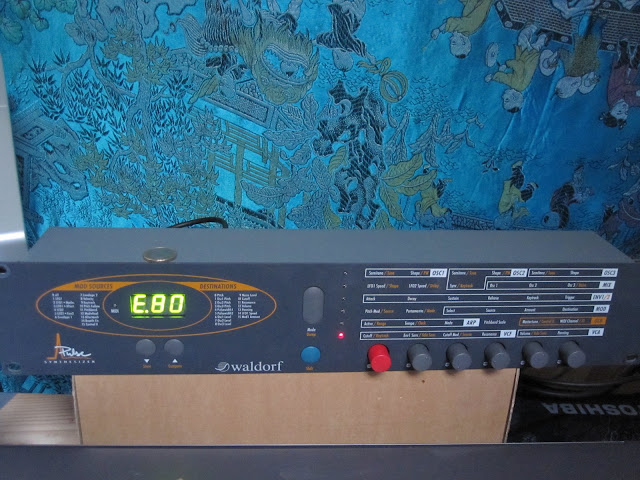
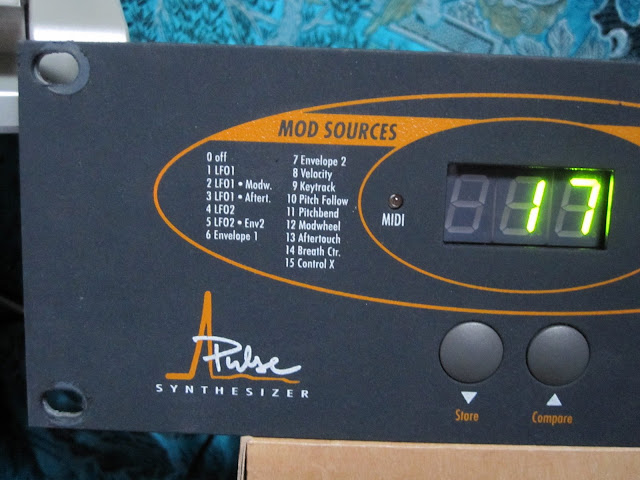


First impressions are very positive! Lovely, ballsy tone. Easy to edit – realtime tweak friendly -now hooked-up and controlled by the X-station.

 NoisyLittleBugger